
The Tiny Unnoticed Adjustment That Makes Nighttime Caregiving Far Less Tiring
A practical little-known tip that eliminates most unnecessary disruptions for both caregivers and the people they look after overnight.
Almost anyone who has spent a full night looking after a family member recovering from minor surgery, a mild fever, or post-treatment fatigue has experienced the same frustrating cycle: you move as quietly as possible, hold your breath when you stand up to check their temperature or refill their water, and still they wake up half an hour later groggy, complaining they could not get any real rest. You spend the entire next day exhausted, wondering if you are just naturally too clumsy to do the simplest care tasks without making noise, and there is almost never any clear explanation for why no one gets a decent stretch of sleep even when everyone seems to be doing everything right. Most people blame the situation on the stress of being unwell, or the caregiver’s unavoidable movement, but the root cause is far simpler, and far easier to fix, than most people ever imagine.
The mistake almost every new caregiver makes is placing their small nighttime light source right on the bedside table, facing up directly toward the upper half of the bed. This makes total logical sense at first glance: the light is within arm’s reach, you can see the patient’s face clearly when you check on them, you can read the numbers on the thermometer and see the drip rate of a hanging IV line without fumbling around in the dark. What most people do not realize is that even the dimmest warm white LED light, if it is positioned within 50 centimeters of a person’s face and aimed directly at their eye area, will penetrate closed eyelids easily and suppress the body’s natural production of melatonin for hours on end. The people being cared for are not being restless or overly sensitive: they are stuck in the lightest possible stage of sleep for the whole night, never sinking into the deep restorative rest that speeds up physical recovery, and they will wake up sore and foggy even if they seem to have slept for seven or eight hours straight.
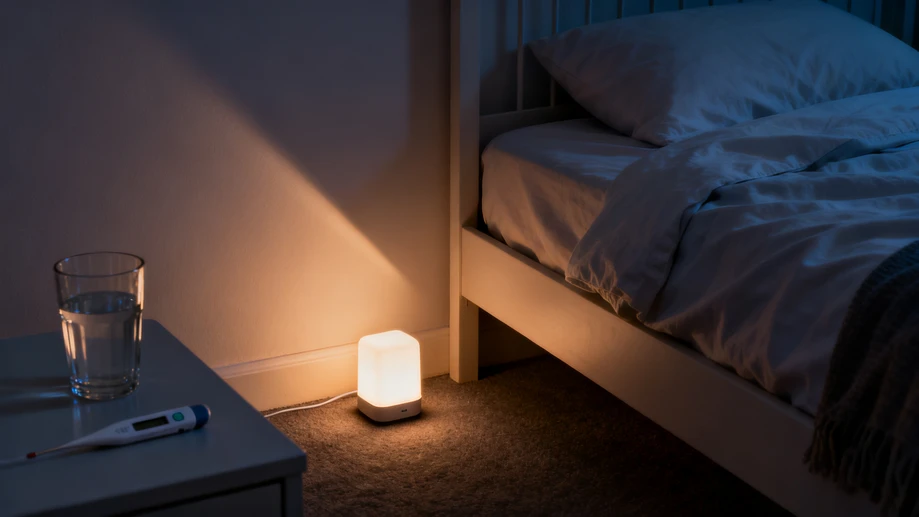
The tiny, game-changing trick that almost no care guide mentions is moving your low-brightness warm night light all the way to the floor, 30 centimeters to the side of the far end of the bed, and angling it to point directly at the nearest empty section of wall instead of the bed itself. The soft diffused glow that bounces off the wall will cover every key walking path in the bedroom perfectly: you can see the edge of the bed when you stand up, you can spot the loose slipper left in the middle of the floor before you trip over it, you can make out the labels on the medicine bottles on the far side of the room, and you never have to turn on a brighter main light at any point through the night. No direct line of light will ever reach the face of the person lying in bed, so their closed eyes stay completely in near-darkness, and their body can produce melatonin normally to slide them into deep, uninterrupted sleep for hours at a time.
This small adjustment requires no special tools or extra spending, and it works far better than most of the fancy overpriced care products marketed to new caregivers. You do not need a special motion-sensor light, you do not need a set of non-slip floor stickers to avoid tripping, you do not even need to buy a new lamp if you already have a basic warm white low-power light at home. The only extra small rule to remember is to never use the built-in flashlight of a mobile phone for night checks, even if you turn the brightness all the way down: the cool blue wavelength of phone light is far more disruptive to melatonin production than even a relatively bright warm LED, and a single two-second flash of that light to check someone’s cheek temperature can pull them straight out of deep sleep without them even remembering being woken up later.
Most people who try this simple position swap for the first time are shocked by how big of a difference it makes, after years of thinking nighttime caregiving has to be a draining, mutually exhausting experience for everyone involved. The whole point of overnight care is not to run around constantly checking on the person you are looking after, it is to create a quiet, low-interference environment that lets them rest as much as possible while you stay comfortable enough to stay alert for any actual emergencies. There is no need for complicated routines or expensive gear to get that result, and most of the best care tips are just this kind of small, common-sense adjustment that no one thinks to talk about until someone points it out out loud.