
The Little Known Bed Positioning Trick That Cuts Household Care Workload By Nearly Half
It introduces a widely overlooked practical family care skill that solves the common frustrating problem of bedridden users sliding down to the foot of the bed, with no extra expensive equipment required.
Almost every person who takes care of a long-term bedridden family member has encountered the same annoying scenario: after spending ten minutes adjusting the back cushion, tucking the limbs to a comfortable angle and turning away to grab a glass of water or prepare medicine, they find the care recipient has slid halfway down the bed within half an hour, slumped at the foot of the mattress with their neck twisted awkwardly and their lower back pressed against the hard bed board. Many first-time caregivers attribute this problem to overly smooth mattress covers, or assume the recipient is unconsciously shifting their weight to move around, and spend extra money on non-slip pads or extra railings to solve the problem, only to find the sliding issue appears again two or three days later, and the new barriers even make it harder to reposition the person when necessary.
What most amateur family caregivers do not realize is that the repeated sliding problem is almost always caused by the wrong repositioning method they use. Most people intuitively grab the care recipient’s shoulders or armpits and pull them straight toward the head of the bed, which creates huge friction between the person’s sacrum, heels and the surface of the mattress. The pulling force often shifts the upper body forward first, while the lower body stays pressed against the mattress, creating an unnoticeable “sliding trace” between the skin and the sheet that makes the next unintended slide even easier, and the repeated friction on the sacrum area is one of the top hidden causes of early stage pressure sores that many families fail to spot in time. This wrong movement also puts huge extra strain on the caregiver’s lower back, leading to frequent muscle strains that make long-term home care far more exhausting than it needs to be.
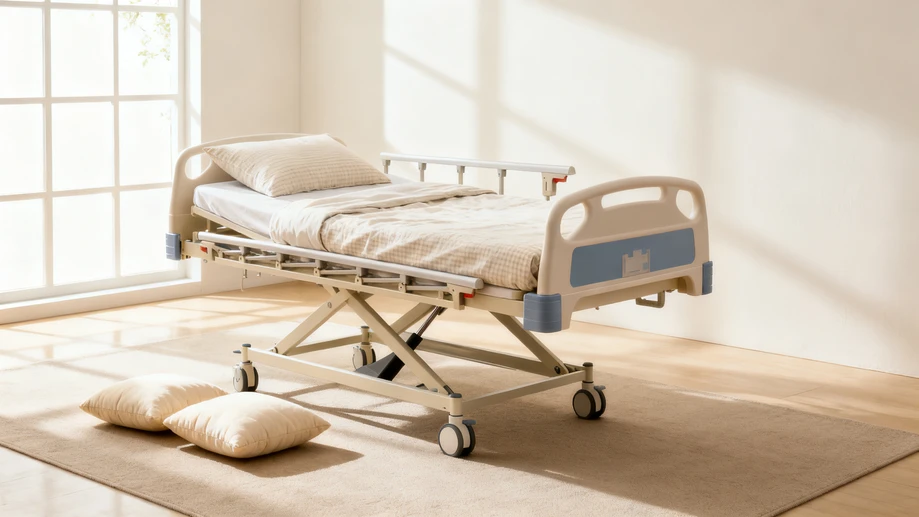
The simple trick that solves all these problems only takes 10 extra seconds before repositioning, and requires no specialized tools at all. Before you try to move the care recipient upward, raise the leg rest section of the bed to around 15 degrees, so that the person’s knees are naturally bent and their feet lie flat against the bed surface with the lower legs fully supported. At this angle, the weight of the whole lower body is distributed evenly across the leg rest and the mattress surface, instead of being concentrated on the small area of the sacrum. You do not need to use both hands to drag the person upward at all: just place one hand gently on the side of their hip closest to you, apply soft steady force toward the head of the bed, and the person’s whole body will move in sync without any part rubbing against the sheet.
After getting used to this small movement, most caregivers find they can finish a full repositioning process in less than one minute, even if they are not particularly strong physically. The number of accidental slides that happen after adjustment drops by over 70 percent in most households, which means caregivers no longer need to go back to the bedroom every 20 minutes to readjust the recipient’s posture, and the risk of redness or damage on the sacrum area reduces dramatically for people who cannot shift their weight on their own. Many families who used to hire temporary helpers for weekly full-body repositioning now find they can handle all the daily adjustment work on their own, cutting a huge part of the long-term care cost that used to take up a large share of the household budget.
This small trick also brings unexpected soft benefits that most people do not count on at first. The care recipient no longer feels the sharp pulling on their shoulders and the uncomfortable dragging sensation across their back every time they are repositioned, so they feel far more relaxed during daily care processes, and less likely to show signs of irritability or resistance when the caregiver needs to adjust their posture. For families that have to take on full-time care duties without extra outside support, these tiny improvements in daily routine add up to reduce long-term mental pressure for every member of the household, making home care feel less like a constant exhausting burden and more like a manageable, gentle daily routine.