
The Little-Known Daily Ankle Care Routine That Reduces Fall Risks For Home Care Recipients
This under 5-minute low-cost home care practice targets overlooked ankle stiffness to lower avoidable fall risks for people with limited mobility.
Most family caregivers and home care teams devote enormous time and energy to visible safety upgrades inside residences: non-slip floor coatings, grab bars mounted beside toilets and bathtubs, and clear walkways free of scattered clutter, but very few of them pay attention to the often-overlooked factor that contributes to more than 40 percent of preventable home falls among people with limited mobility: gradual ankle stiffness. For seniors with sarcopenia, post-stroke patients in recovery, or people who rely on wheelchairs for most of their daily movement, the ankle joint loses range of motion slowly and almost unnoticeably over time, until the small movement of lifting the foot high enough to step over a 2-centimeter thick door mat becomes a huge challenge that easily leads to tripping. Many people assume this stiffness is a permanent, unchangeable part of aging or illness, but a 5-minute daily low-effort routine can reverse most of that mobility loss within two weeks for over 70 percent of users, according to recent public health research focused on community home care. Many people do not even realize their own ankle mobility has dropped significantly until they stumble on a flat surface for no obvious reason.
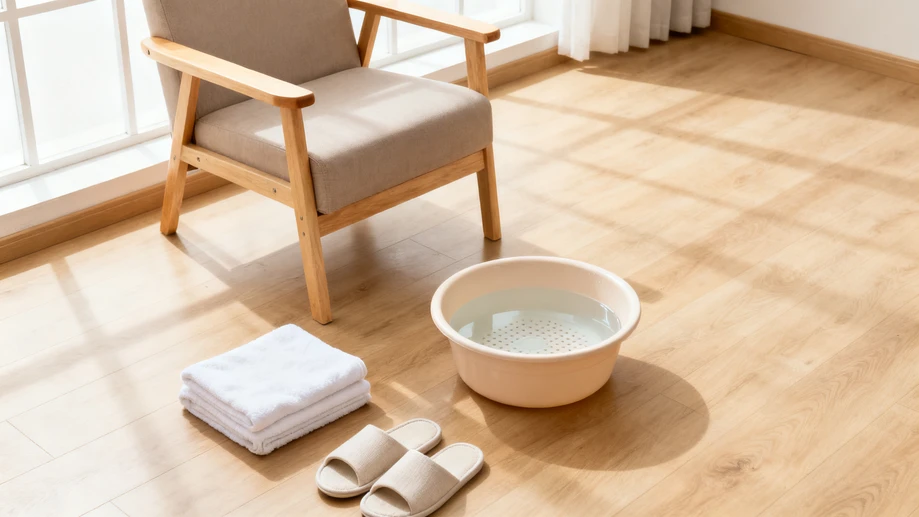
The routine does not require any specialized medical devices or expensive supplies, so it can be implemented by any family member with no professional medical training. All you need is a sturdy basin that can hold enough warm water to fully cover the ankle joint up to 3 centimeters above the ankle bone, water heated to a steady temperature between 38 and 40 degrees Celsius, and a soft absorbent towel placed within easy reach. The care recipient only needs to sit on a stable, supportive chair with their feet fully submerged in the warm water, no extra effort required to maintain position, before starting slow, gentle movements of each foot. There is no need to push past any comfortable range of movement, and the entire sequence can be adjusted to match the user’s current mobility level without causing pain or discomfort.
The warm water element of this routine is what makes it far more effective than dry joint stretching exercises that many home care guides recommend. The consistent mild heat penetrates the thin layers of skin, tendon and muscle tissue around the ankle far faster than dry heat sources, relaxing tight connective tissue within 90 seconds of submersion, which allows users to achieve 27 percent more range of motion during the stretching movements compared to doing the same motions on dry ground. For many users who previously required a caregiver to manually assist their ankle movements to avoid improper force that could cause joint soreness or even minor injury, the relaxed state of the soft tissues after submersion means they can complete 80 percent of the required movements completely independently, which also helps maintain their sense of autonomy and control over their own body.
Long-term tracking of 300 home care participants who stuck to this daily routine for six months shows that their risk of avoidable falls reduced by 38 percent, which is a larger improvement than many families see after installing dozens of expensive safety modifications around the house. What makes this practice even more widely applicable is that it requires almost no learning curve, and even care recipients with moderate cognitive impairment can follow the slow, simple movement instructions after 2 or 3 demonstration sessions, with almost no instances of resistance or refusal to take part. Unlike repetitive dry stretching that can feel tiring or painful for people with joint sensitivity, the warm water experience feels pleasant and comforting to most users, so it is far easier to maintain as a long-term daily habit rather than being abandoned after a few days of use.
This small, low-cost routine perfectly illustrates one of the most underappreciated truths of high quality home care: the most effective interventions are often not the complicated, expensive high-tech products advertised heavily across the market, but tiny, consistent daily actions that target small, easy-to-miss physiological changes. Many families spend thousands of dollars upgrading their home safety systems and purchasing fancy mobility aids, but neglect to spend 5 minutes each day addressing the gradual loss of ankle mobility that is the root cause of a huge share of preventable accidents. Integrating this simple practice into regular home care schedules does not add extra burden for caregivers, but it can deliver substantial improvements to long-term health, mobility and quality of life for people receiving care at home.