
The little known daily care tip that helps family caregivers easily cut pressure sore risks for long-term bedridden people
This practical trick guides non-professional caregivers to adjust bedridden people’s side lying angle to 30 degrees instead of 90 degrees to avoid unnecessary skin damage in daily home care scenarios
Most informal family caregivers who have just started taking care of long-term bedridden people have heard the basic rule of turning the body over every two hours to prevent pressure sores, but a large proportion of them fall into the common operational mistake that almost no popular science content reminds people of. Most novices tend to turn the care recipient to a full 90-degree side lying position directly after lifting their body to the edge of the bed, assuming this posture completely keeps the sacrum and tailbone away from contact with the mattress to reduce pressure. What they do not realize is that this seemingly reasonable operation shifts all the concentrated pressure that used to fall on the lower spine area to several thinner, more fragile bone protrusions around the hip, shoulder and cheek, which increases the risk of redness, damage and eventual pressure sore formation on these neglected parts.
The core of this underrated practical care tip is to control the side lying angle of the bedridden person stably at 30 degrees, rather than the common 90 degrees, and the entire operation process does not require extra professional skills or expensive specialized equipment. Before turning the body, first move the bedridden person slowly to the side of the bed close to you, so that their body is located at the position 30 centimeters away from the edge of the bed, then support their shoulder on the far side and the hip on the far side at the same time, and turn their whole body gently towards you to the 30 degree inclination. After that, place a thick folded support pad stably behind their back to prevent the body from rolling back to the flat position, then place a soft cushion between the two bent knees, and tuck a small thin pillow under the suspended ankle to avoid direct friction and compression between the bony protrusions of the lower limbs.
The 30-degree side lying posture is far more friendly to the skin and soft tissue of bedridden people than the 90-degree posture, and the difference in pressure distribution after the angle adjustment has been verified in multiple community care practice projects. When the human body maintains a 90-degree side lying posture, most of the weight is concentrated on the greater trochanter of the femur at the hip, the acromion of the shoulder and the lateral auricle, where the subcutaneous fat layer is extremely thin, and the local blood circulation is easily blocked by continuous compression even if the turning interval is strictly controlled at two hours. At a 30-degree inclination, the weight of the whole body is evenly distributed to the thicker gluteal muscle tissue on the back side, the soft muscle area around the ilium and the back side of the thigh, and these parts have sufficient subcutaneous fat and capillary distribution, which can effectively avoid the local ischemia problem caused by concentrated pressure, and the actual pressure sore risk can be reduced by more than 70% according to the statistics of community care workers.
Beyond the obvious effect of reducing pressure sore risk, this tiny posture adjustment also brings many unexpected additional benefits for both care recipients and caregivers. For the people being taken care of, the 30-degree side lying position will not produce the strong sliding tendency towards the end of the bed that often occurs in the 90-degree side lying position, so they do not need to be dragged up to the head of the bed again and again within a short period after turning over, and unnecessary body pulling can also reduce the chance of secondary injury to the musculoskeletal of people with limited mobility. This angle is also more suitable for people who need to take food and medicine in bed, it can effectively reduce the risk of food reflux and accidental aspiration, and the small inclination can also help patients with mild phlegm symptoms to drain sputum smoothly compared with the flat lying posture. For caregivers, this operation does not need to use too much force to turn the whole person to the vertical side, which greatly reduces the load on the caregiver's own waist and arm muscles, and avoids the occupational strain that many family caregivers unknowingly suffer from in the long-term care process.
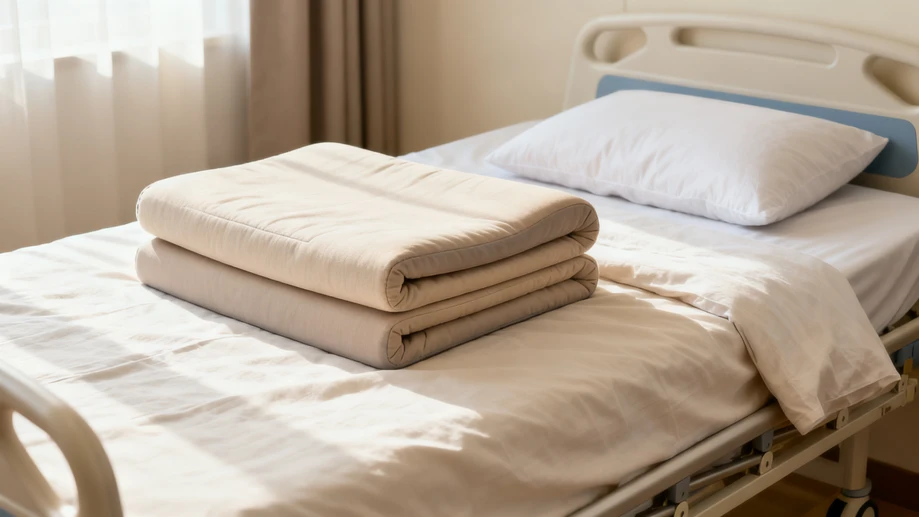
People do not need to prepare special custom-made medical wedge cushions at high cost to implement this small care skill at home. Folded thick cotton quilts, stacked wool blankets, or several rolled soft cotton blankets spliced together can provide stable and soft support enough to maintain the 30-degree angle, and hard objects such as hard back books, plastic boards and hard foam pads should never be used as support, because the hard material will form new local pressure points on the contact surface with the skin. After the support is fixed every time, caregivers can reach the gap between the pad and the skin with their hands to check whether there are raised edges or hard protrusions causing partial compression, and observe the skin state of the hip, lateral ankle and shoulder joint carefully every day. Once slight persistent redness appears on a certain part, shorten the interval between turning over appropriately, and the damaged skin can return to normal in a short time without developing into a stubborn pressure sore.